Our patients with chronic conditions stick around. And that's good for ROI.

Healthier people bring a range of benefits for society. One of the most enduring arguments for public healthcare financing is that it addresses the disconnect between what can be unprofitable for an insurer but very good for society overall.  The term policy analysts and the Robert Wood Johnson Foundation use for these types of situations—where there is a strong return on investment (ROI) but not for the entity bearing the investment cost—is a “wrong pocket problem.”

Chronic disease management is one such area. Delaying onset of the major consequences of chronic disease saves money—keeping people healthy allows them to be economically productive, and it reduces expensive medical costs such as hospitalization and dialysis. However, because chronic disease consequences build over time, the savings are in the future. It is a perfect area for public healthcare financing.

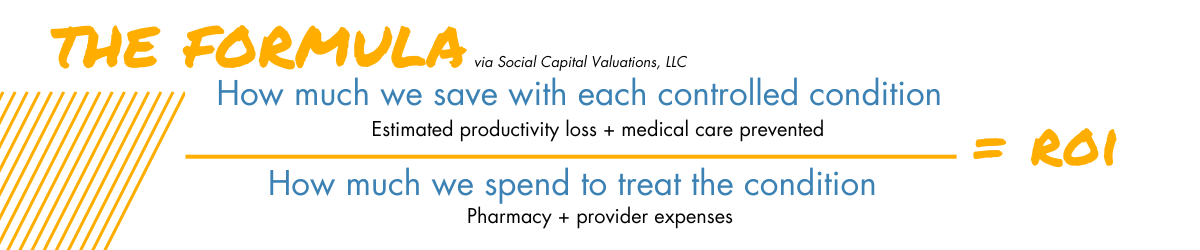
The Formula:How much we save with each controlled condition (Productivity loss + medical care prevented)/How much we spend to treat the condition (Pharmacy + Provider expenses)

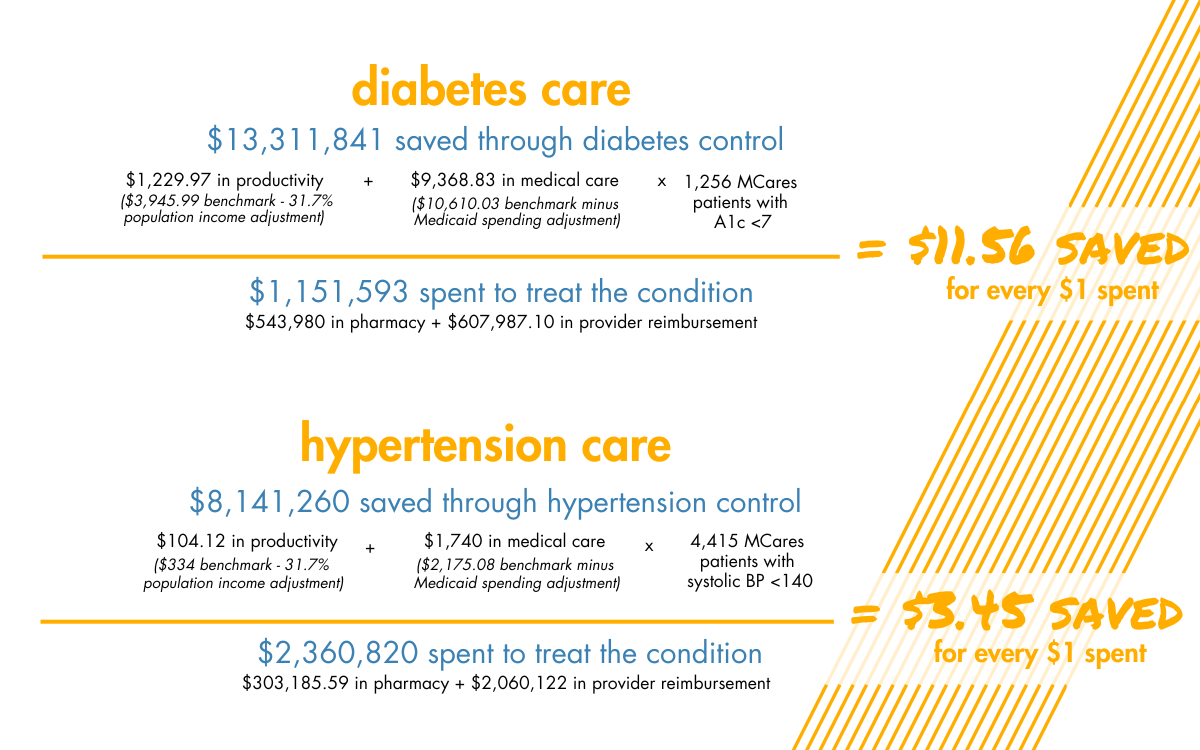
Montgomery Cares (MCares) is a public-private partnership providing coordinated primary, behavioral, and specialty care to adult residents of Montgomery County, Maryland with incomes at or below 250% of the federal poverty level and no insurance. Social Capital Valuations, LLC analyzed the overall return on investment for chronic disease-specific treatment through MCares in FY19. PCC repeated the ROI analysis on FY22 data* with the following results (in 2021 dollars):

FY22 Results
Diabetes ROI = $11.56Hypertension ROI = $3.45

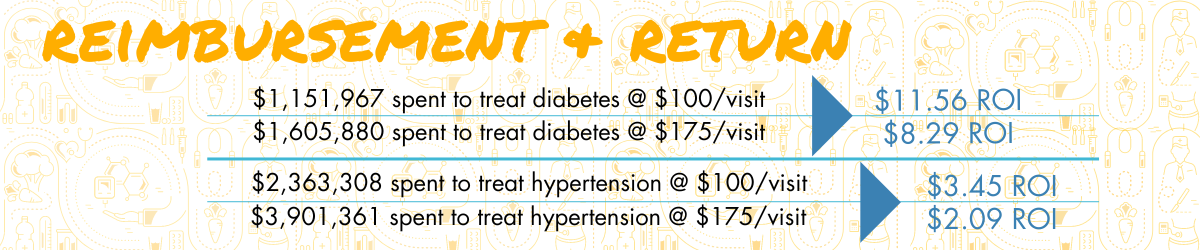
One caveat to note is that these investment numbers are artificially low because County funding, including per-visit reimbursement, is well below the actual cost of care. These calculations also exclude the indirect costs for PCC to manage MCares billing and reimbursement, which were 8.28% in FY22. But even if the encounter cost had met the target reimbursement rate of $175—70% of the roughly $250 average Medicaid reimbursement—the ROI would still be significant:

Reimbursement and Return:Diabetes ROI @ $100/visit = $11.56Diabetes ROI @ $175/visit = $8.29Hypertension ROI @ $100/visit = $3.45Hypertension ROI @ $175/visit = $2.09 ROI

Put another way, even the higher cost of care is worth the investment in economic terms alone.

So, when we run the MCares retention data and see that many of our most enduring patients are the ones with chronic conditions, it may actually be reason to celebrate. It means we’ve succeeded in connecting with the people who benefit the most—and whose care benefits the rest of us, too.

Of course, there are things this analysis doesn’t tell us. One of the biggest being how those benefits actually break down across our local ecosystem. The bottom line, though, is that county government is in the business of producing public good, and the analysis suggests Montgomery Cares provides just that.

While some returns may end up in the wrong pocket, the overall benefit is in the right pants.


*PCC adapted SCV's provider reimbursement calculation methodology due to pandemic-era block payments in effect during FY22 (FY19 analysis was based on fee-for-service reimbursement).

This article has not been reviewed or approved by the Montgomery County Department of Health and Human Services.


8757 Georgia Ave, 10th Floor | Silver Spring, Maryland 20910
Question? Email us at stephanie_narayanan@primarycarecoalition.org or call 301-628-3456

Follow Us

Having trouble viewing this email? View it in your web browser

Unsubscribe or Manage Your Preferences